







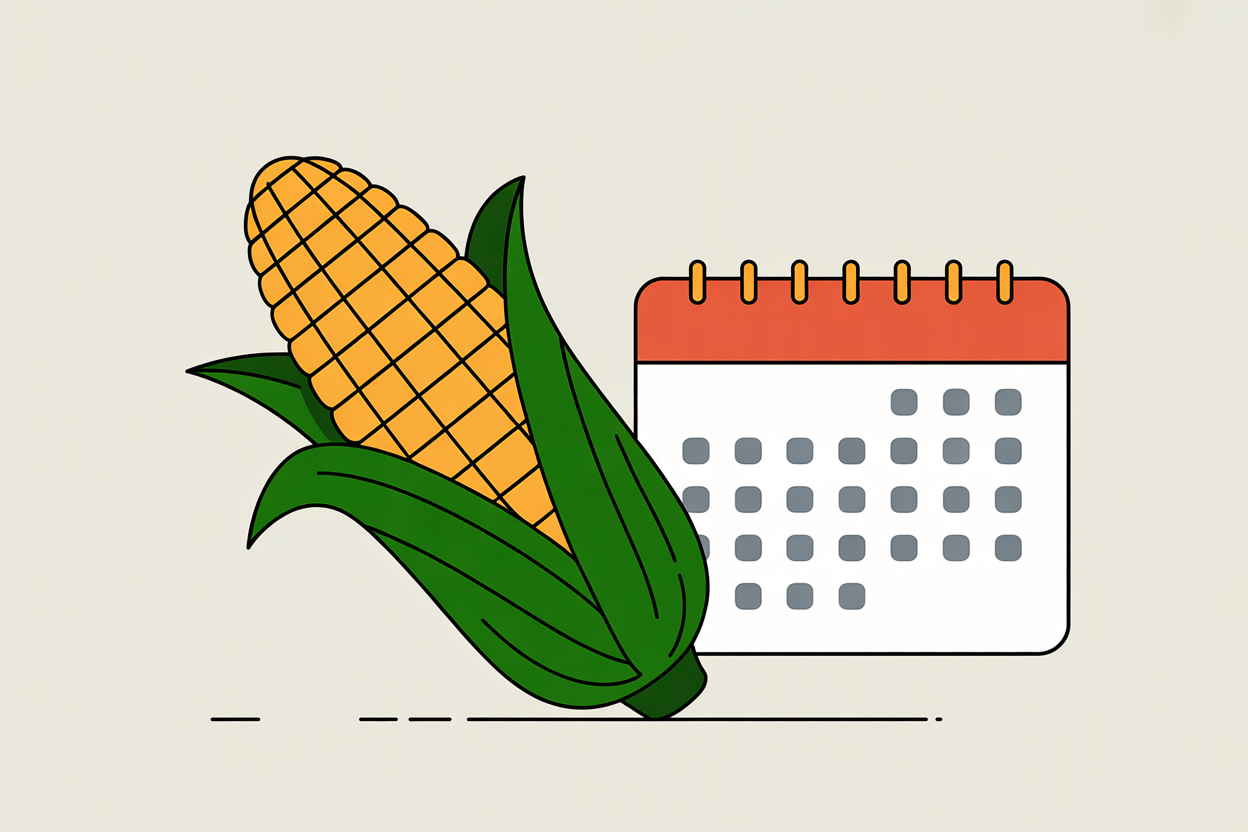
Tired of planting corn in your Central Florida garden only to get small ears or stalks that fail in summer heat? The fix is timing. For Central Florida, the best planting window is mid-February through late March. A second, riskier window opens in August through early September. Plant outside those times, and heat, storms, and poor pollination can cut your crop fast.
Corn usually matures in 60 to 90 days, but Central Florida weather can speed up or ruin that schedule. Your goal is to get corn up in cool soil, grow it before summer heat peaks, and harvest before storms or cold fronts cause problems.
Central Florida Corn Planting at a Glance
| Central Florida Corn Planting Snapshot | |
|---|---|
| Month/Window | What to Do |
| January | Possible early start in a frost-free spot. High risk. |
| Mid-Feb – Late March | Best spring planting window. |
| April | Last call for spring corn. Use early varieties. |
| May – Mid-July | Avoid planting. Heat and humidity reduce pollination. |
| Aug – Early/Mid-Sep | Second planting window. Higher risk from pests and storms. |
Know Your Central Florida Growing Conditions
Central Florida is different from the Midwest. Corn has to handle fast heat, sandy soil, and heavy summer rain.
- Sandy soil warms fast but loses water and nutrients quickly.
- High heat hurts pollen. Poor pollination leads to ears with missing kernels.
- Storms can lodge corn. Strong wind and rain can flatten stalks.
- Soil needs building. Compost and regular feeding matter here.
Best Corn Varieties for Central Florida by Season
| Season/Window | Recommended Varieties | Why They Work Here |
|---|---|---|
| Main Spring (Mid-Feb–Late Mar) | ‘Silver Queen’, ‘G90’ | Reliable and mature before peak summer heat. |
| Late Spring Edge (Early Apr) | ‘Early Sunglow’ | Faster maturing for a short window. |
| Late Summer/Fall (Aug–Early Sep) | ‘Bodacious RM’, ‘Sweet Ice’ | Better choice for hot late-season planting. |
Use these rules:
- Match the variety to the window. Short-season types work better when time is tight.
- Do not push late planting into summer. Heat can ruin pollination.
- Plant in blocks. Corn pollinates better in short rows than in one long row.
Month-by-Month Corn Planting Guide for Central Florida
January: Decide If an Early Start Makes Sense
January planting is possible only in a warm year and a protected spot.
- Check soil temperature first. Corn needs warm soil to start well.
- Use row covers if needed. A cold snap can damage seedlings.
- Keep the planting small. Use January for a test patch, not your full crop.
February: Prime Time Begins
Mid-February is the best time to start spring corn.
- Plant in full sun. Corn needs 6 to 8 hours of direct light.
- Use proper spacing. Plant seeds about 1 inch deep and 6 to 8 inches apart.
- Plant in blocks. Use at least 3 to 4 short rows for better pollination.
- Apply starter fertilizer at planting.
March: Peak Spring Plantings
March is the sweet spot for Central Florida.
- Plant your main crop now if you have not already.
- Use proven varieties like ‘Silver Queen’ or ‘G90’.
- Keep soil evenly moist.
- Plan side-dressing when plants reach knee-high size.
April: Last Call for Spring Corn
April is the final spring chance, but risk rises fast.
- Choose fast-maturing varieties such as ‘Early Sunglow’.
- Watch watering closely as temperatures rise.
- Keep air moving by spacing plants well.
- Expect more risk if planting late in the month.
May to Mid-July: The “Do Not Plant” Window
Do not plant corn during this period.
- Heat reduces pollination.
- Pests build fast.
- Storms can damage stalks.
- Focus on the crop already in the ground.
August: Second Chance for a Fall Crop
August can work, but the crop faces more stress.
- Use heat-tolerant varieties.
- Plant early in the month if possible.
- Water deeply and often.
- Scout for pests every week.
Early to Mid-September: Final Fall Planting Window
This is the last usable window.
- Expect more weather risk.
- Choose the fastest varieties.
- Keep spacing open for airflow.
- Harvest promptly when ready.
October to December: Harvest, Rest, and Prep
This period is for harvest and soil prep.
- Check for ripe ears.
- Pull stalks after harvest.
- Add compost to the bed.
- Run a soil test before next spring.
Setting Up Your Central Florida Corn Plot
Start with good soil and a clean bed.
- Add compost. Work several inches into the top 8 to 10 inches of soil.
- Check pH. Corn grows best at pH 6.0 to 6.8.
- Do not use fresh manure.
- Plant in blocks, not single rows.
Soil Testing Through UF/IFAS
Before planting, test the soil through your local UF/IFAS Extension office.
Step-by-Step Soil Test Process
- Get sample bags and forms at your county UF/IFAS Extension office. Ask for Form SL136/SS187.
- Collect soil from 10 to 15 spots in a zigzag path across the garden.
- Take samples from the top 6 inches.
- Mix the samples in a clean plastic bucket.
- Air-dry the soil on newspaper. Do not mail wet soil.
- Fill the sample bag to the dotted line, about 1 pint.
- Complete the form and include payment by check or money order.
- Mail it to the Extension Soil Testing Laboratory (ESTL).
- Use the report to check pH, phosphorus, potassium, and lime needs.
What to Look For in Results
| Soil Test Result | What It Means |
|---|---|
| pH below 6.0 | Lime may be needed. |
| pH above 6.8 | Lower pH may be needed. |
| Low phosphorus | Use a starter fertilizer with phosphorus. |
| Low potassium | Add potassium before planting or side-dress if needed. |
Planting Window and Temperature
Corn needs warm soil and stable nights.
| Condition | Best Range |
|---|---|
| Minimum soil temp at planting depth | 50°F |
| Preferred soil temp for strong emergence | 60°F to 70°F |
| Night air temp during planting | Stay above 50°F |
If the soil is too cool, corn can sprout slowly or unevenly.
Fertilization Strategy
Sandy soil loses nutrients fast, so split feeding works best.
Starter Fertilizer at Planting
Use a high-phosphate starter such as 10-34-0 or 8-32-16.
- Place it 2 inches to the side and 2 inches below the seed.
- Include zinc if your soil test suggests it.
- Keep the starter light. A general guide is 10 to 30 lbs of nitrogen per acre in the starter if using a split plan.
Side-Dressing at Rapid Growth
Apply the rest of the nitrogen when corn is knee-high or about 12 to 15 inches tall.
- Put fertilizer along the row, not against the stalk.
- Water it in after application.
- Stop heavy nitrogen once tassels appear.
Watering Schedule for Sandy Soil
Corn in Central Florida needs steady water. Sandy soil dries fast, so split watering is better than one long soak.
| Growth Stage | Water Need | Practical Schedule |
|---|---|---|
| Germination | Keep soil moist | Light watering as needed, often every 1 to 2 days |
| Vegetative growth | About 1 inch per week | Split into 2 watering sessions of 0.5 inch each |
| Silking and pollination | 1.5 to 2.3 inches per week | 0.25 to 0.5 inch every 2 to 3 days |
| Ear fill | 1.5 to 2.3 inches per week | Keep soil evenly moist; do not let it dry out |
Watering Notes by Stage
- Germination: Keep the top 1 to 2 inches moist until seedlings emerge.
- Vegetative growth: Water deeply enough to wet the top 6 inches of soil.
- Silking: This is the most critical time. Dry soil here means poor kernel set.
- Ear filling: Keep watering steady until kernels fill the ear.
Common Pests and Problems by Season
Scout every week. Catching pests early is much easier than fixing major damage.
Common Pests
| Pest | Signs | Organic Control |
|---|---|---|
| Caterpillars / armyworms / earworms | Chewed leaves, damaged silks, holes in ears | Bt or spinosad |
| Aphids / whiteflies | Sticky leaves, curled growth, small soft-bodied insects | Insecticidal soap, horticultural oil, or rosemary oil |
| Stink bugs / beetles | Punctured kernels, feeding damage | Kaolin clay (Surround) |
Organic Spray Guide
- Bt for caterpillars: Use on young larvae. Reapply after rain and follow the label.
- Spinosad: Useful on caterpillars when Bt is not enough.
- Insecticidal soap: Best for aphids and whiteflies. Spray the pest directly.
- Horticultural oil: Use on cool days and avoid spraying in hot sun.
- Neem oil: Mix 1 to 2 tablespoons per gallon of water for general use, unless the label says otherwise.
- Kaolin clay: Forms a coating that can reduce feeding and egg-laying.
Rotate products week to week if needed, and always follow the label.
How to Tell When Central Florida Corn Is Ready to Harvest
Hot weather can move corn along fast, so use ear signs instead of the calendar alone.
- Silks turn brown and dry.
- Ears feel full and firm.
- Kernels are plump all the way to the tip.
- Harvest ears in stages since they may not mature at the same time.
- Cook or chill soon after picking.
Simple Central Florida Corn Success Checklist
- Plant in the right window: mid-February to late March, or early August to early September.
- Check soil temperature: aim for 60°F to 70°F.
- Test your soil through UF/IFAS.
- Add compost and use the right pH.
- Use a starter fertilizer and side-dress later.
- Water by growth stage.
- Scout for pests weekly.
- Harvest as soon as ears are ripe.
Frequently Asked Questions
1. What month do you plant corn in Florida?
For Central Florida, the best planting window is mid-February through late March. A second, riskier window is August through early September.
2. How much do farmers make off 1 acre of corn?
This guide is for home growing. Profit depends on crop type, yield, inputs, and market price.
3. Is October too late to plant corn?
Yes. In Central Florida, October is too late for corn.
4. Why is it illegal to replant corn?
It is not illegal to replant open-pollinated corn from your own garden. Restrictions apply to some patented commercial seed types.